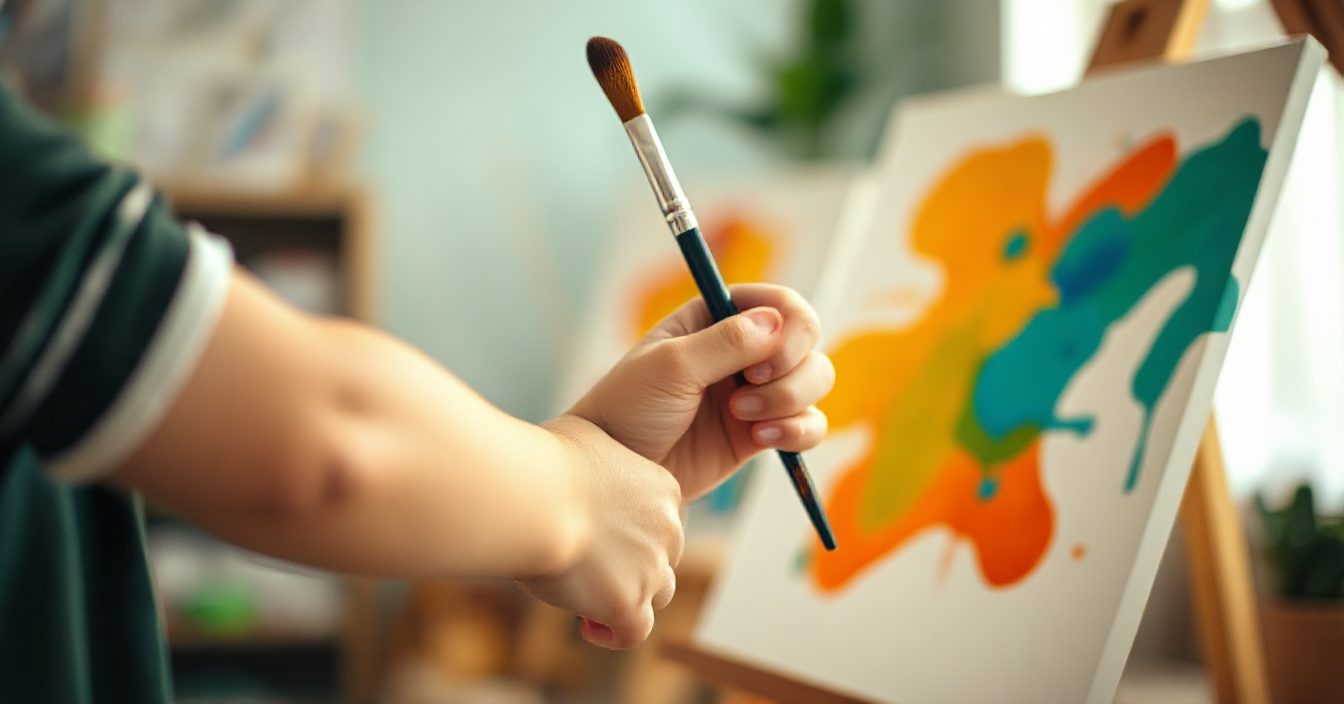
It's after dinner and the crayons are scattered across the table. Your child reaches for the blue one and asks if you'll make a picture together. That small moment can be more than fun — it can be quiet practice in focus and planning.
You don't need a special kit or a clinic program to make that happen. A few gentle tweaks to your art time are plenty.
There's some lovely thinking behind this, too. A 2026 reflection by Sukardani and colleagues suggests that visual art — images, patterns, shapes, repeated interaction — may create conditions for focus, memory, recognition, and understanding in autistic children. They describe it not as pressure or correction, but as a patient space where learning unfolds at its own rhythm. That framing stayed with me.
She is a perfectionist about her art, so the thing she loves most is the thing her self-critic goes after hardest. That's part of why I keep our art time low-stakes.
Make Art Sessions Easier to Settle Into
Before the creativity starts, a little structure helps the whole thing feel calmer.
- Set a visual timer. Use a kitchen timer or a phone app that shows the countdown. When it buzzes, pause together and ask what's been made so far. It gives your child a sense of how long they've been working.
- Write a three-step list. On a sticky note, jot down: gather supplies, follow the idea, clean up. Let your child tick each box. Seeing the checks land makes the sequence feel real and doable.
- Clear the table. Pick a quiet corner, turn off the TV, and keep out only what you need. A calmer space means fewer things competing for attention, so progress is easier to notice.
Lean Into the Senses
Autistic kids often take in the world through texture, sound, and smell. Art time is a friendly place to use that.
- Offer different textures. Put out sandpaper, fabric scraps, clay, and sponges. Let your child touch each one before they begin. The variety can hold attention and feel genuinely good.
- Keep music low. Try soft instrumental tracks in the background, quiet enough to be a backdrop. Watch whether a steady rhythm helps your child stay with the task.
- Add a scent cue. Dab a cotton ball with a calming scent and set it nearby. Over time it becomes a little signal that art time is starting, which helps with the transition in.
Turn Creativity into Planning Practice
This is where the focus and planning really live. None of it needs to feel like a lesson.
- Sketch a tiny map. Before the main project, ask your child to draw a quick outline of what they want to make. A small plan turns an open-ended idea into something reachable.
- Choose a theme together. Pick one for the week — under the sea, a favorite season, a superhero. Deciding together is its own bit of planning, and it builds a little excitement.
- Talk about the finished piece. Spend a minute asking what part they're proud of and what they might try next time. For a perfectionist, I keep that conversation warm and short, so reflection doesn't turn into self-criticism.
A Gentle Word on Screens
Not every child reaches for crayons, and that's fine. Some settle more easily in front of a tablet.
- Try a drawing app. A simple art app can be a comfortable, low-mess way in. A 2018 review by Grossard and colleagues found that technology tools like serious games show promising results for children with autism working on social skills, though they note the clinical validation isn't always complete. So treat it as one option to explore, not a fix.
- Create side by side. If your child is drawing on a screen, pull up a chair and make something too. The shared doing often matters more than the tool.
- Save and revisit. Keep a folder of finished pieces. Looking back at what they made last week is its own quiet reminder of progress.
I'll say the obvious thing out loud: I'm a parent, not a doctor. If you have real worries about your child's attention or planning, your pediatrician is the right person to ask. The ideas here are low-cost, low-pressure, and safe to try this afternoon.
What I love about art time is how forgiving it is. There's no wrong way to make a picture. The timer, the checklist, the little map — they're scaffolding, and you can take any of them away once your child doesn't need it anymore.
Some days the picture gets finished and some days it doesn't, and both are okay. The practice is in the sitting down, the choosing, the pausing to look. That's the part that carries over into everything else.
What art activities have helped your child stay focused or plan a little better? Share your stories in the comments — I'd love to borrow your ideas.
Sources
- Sukardani, Pramana, Setianingrum (2026). Silent images, growing minds. Arts & Health. PMID 42045113
- Grossard, Palestra, Xavier, Chetouani, Grynszpan, Cohen (2018). ICT and autism care: state of the art. Current Opinion in Psychiatry. PMID 30256263