Do you ever wonder what's happening in your child's brain when they can't start a task? Or when focus slips away mid-sentence? You want a real way to understand those moments. The answer may be closer than you think.
My daughter notices what everyone else misses: a bird on a branch, the feathers, the colors, the worm in its mouth. She holds that snapshot and draws it later, in detail.
What EEG actually shows
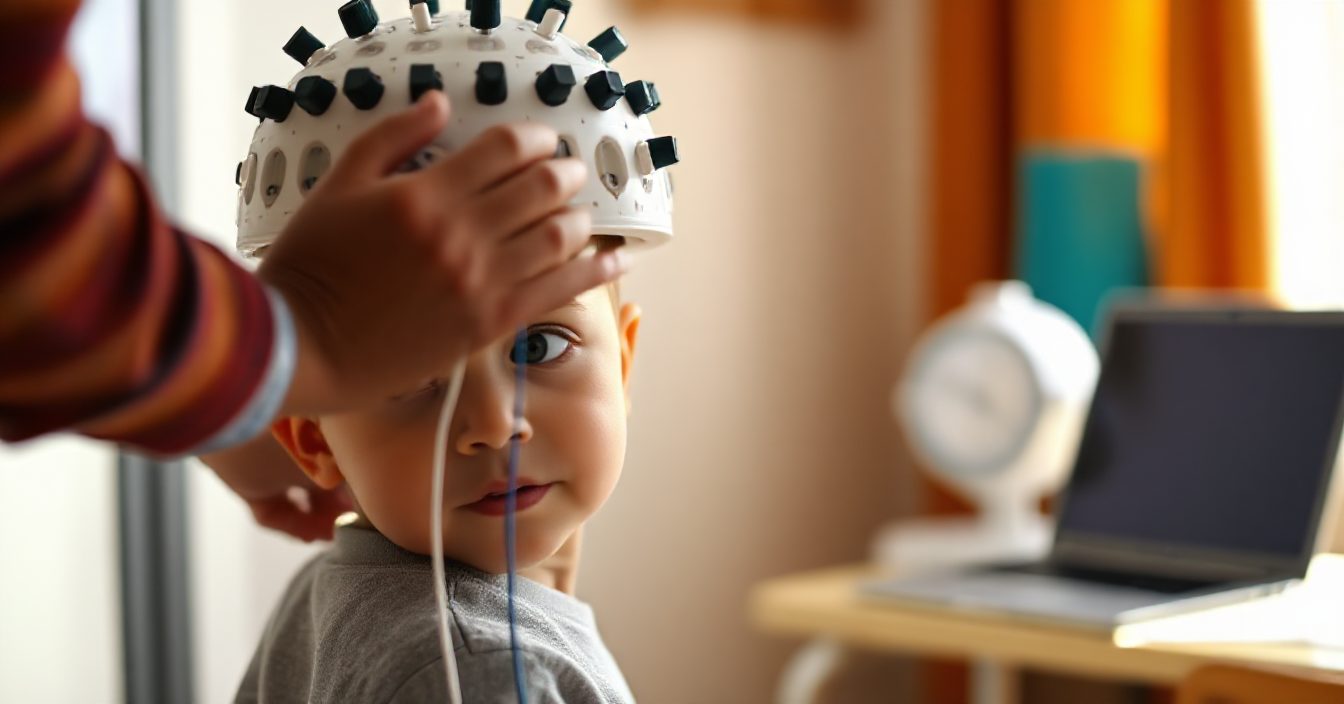
EEG, or electroencephalography, records brain activity through small sensors on the scalp. It's painless. It gives researchers a window into the rhythms behind attention and planning.
A 2013 review by De La Fuente and colleagues pulled together brain studies in ADHD, including EEG. They found that the deficits show up especially in the attention and executive function networks of the brain. This was true in both children and adults.
That matters for us as parents. The struggle to start, focus, and finish isn't laziness. It traces back to how certain brain networks work.
ADHD is rarely one single thing
It helps to let go of the idea that there's one switch to flip. A 2024 study by Peisch and Arnett had children aged 7 to 11 with ADHD, plus a comparison group, complete EEG recordings and thinking tests.
They found that ADHD symptoms came from several sources at once. Patterns in brain activity and patterns in cognitive control each added their own piece. In other words, it's layered. So our support can be layered too.
Everyday steps you can try
You don't need a lab to use these ideas. Here are small, plain things that line up with what the research describes.
- Watch for the hard moments. Notice when starting, focusing, or finishing falls apart. Before school? During homework? After screens? You'll start to see a pattern you can plan around.
- Build in movement. A 2022 study by Ludyga and colleagues had children with ADHD aged 8 to 12 do judo for 120 minutes a week over three months. Afterward, the judo group showed stronger working memory and a matching change in their brain signal. A short, active break before a demanding task can't hurt and may help.
- Break the task down. Split an assignment into small steps. Pair each step with a picture or a check-off box. Seeing the next piece clearly takes pressure off the planning part of the brain.
- Keep a simple log. Jot down what you notice for a week. Our log is what finally showed us her reflection scores dropped around her cycle. A log turns scattered moments into something you can actually act on.
- Pick one skill at a time. Executive skills grow unevenly. Choose one for the month, like estimating time or sequencing steps. One focus is easier for everyone to hold.
- Talk to your provider. If your child has had any EEG or evaluation, bring the summary to your pediatrician or neurologist. Ask how the findings connect to attention and planning. Ask what else, if anything, is worth checking.
Where the brain and practice meet
Here's the part I find hopeful. The brain isn't fixed in place. A 2022 study by Bach-Morrow and colleagues ran a double-blind trial with 46 children with ADHD, ages 6 to 18.
The 23 children who did an EEG-based training program improved on tests tied to executive function and memory. Their EEG also showed more activity in the front of the brain, the region linked to attention and planning. Practice and brain activity moved together.
That doesn't mean one program is the answer for every child. It means the skills we work on at home are connected to real brain patterns. Small, steady practice is worth doing.
A gentle week, not a perfect one
You don't need a rigid chart. Try picking just two of the steps above and spreading them across the week.
Maybe Monday you simply watch and notice. Midweek you add a two-minute movement break before homework. By the weekend you look back at your log and keep what helped. Drop what didn't.
The goal isn't to replace anything your child's care team recommends. It's to add a layer of understanding that makes your everyday support a little more precise.
And remember what the research keeps showing. These are brain networks, not character flaws. When we respond that way, the hard moments feel less like battles and more like puzzles we solve together.
Have you used any brain-based insight, from an EEG or an evaluation, to shape your child's routines at home? What helped, and what fell flat? Share your stories in the comments so we can learn from each other.
Sources
- De La Fuente A, Xia S, Branch C, Li X (2013). A review of attention-deficit/hyperactivity disorder from the perspective of brain networks. Frontiers in Human Neuroscience. PMID 23720619
- Peisch V, Arnett AB (2024). Neural activation, cognitive control, and attention deficit hyperactivity disorder: Evaluating three competing etiological models. Development and Psychopathology. PMID 36345654
- Ludyga S, Mücke M, Leuenberger R, Bruggisser F, Pühse U, Gerber M (2022). Behavioral and neurocognitive effects of judo training on working memory capacity in children with ADHD: A randomized controlled trial. NeuroImage: Clinical. PMID 35988343
- Bach-Morrow L, Boccalatte A, DeRosa J, Devos H, Garcia-Sanchez C, Inglese M (2022). Functional changes in prefrontal cortex following frequency-specific training. Scientific Reports. PMID 36434008