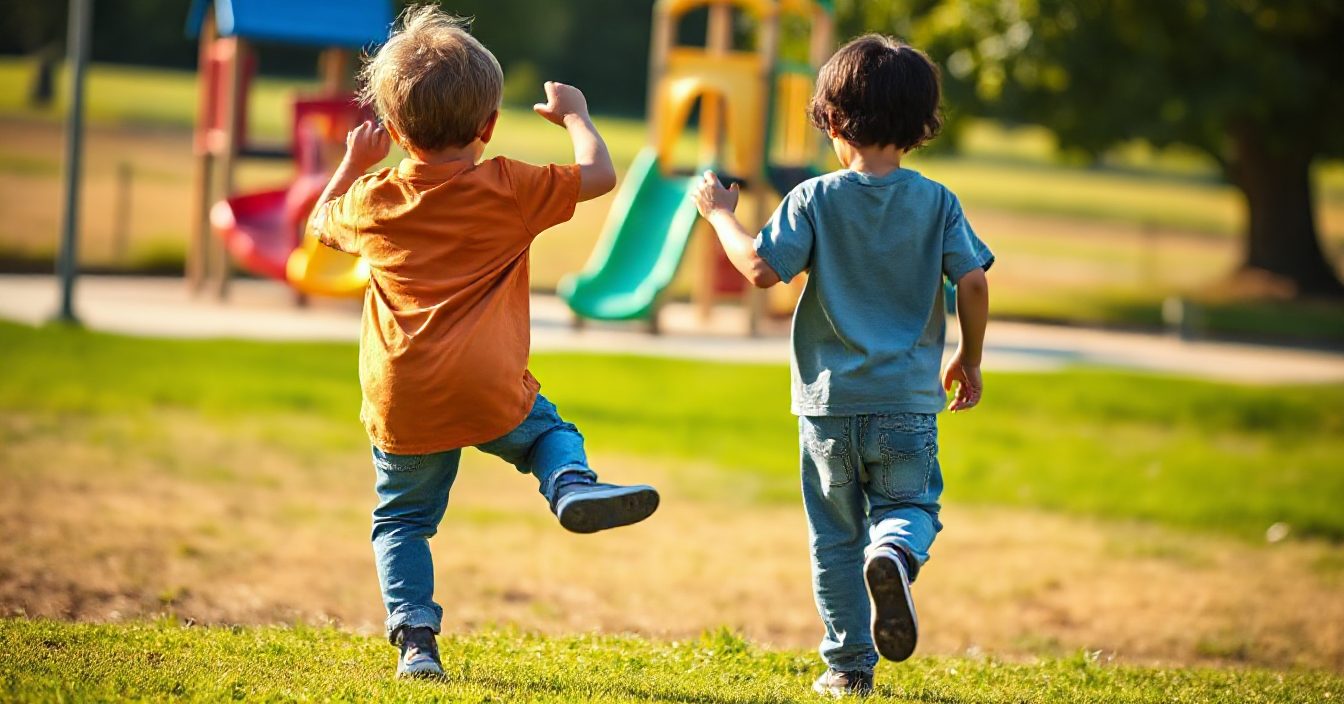
Does your child's focus seem to drain away by the end of a long day? You are not imagining it. A little movement may help more than you expect.
I read a lot of the research as a parent, not a scientist. What keeps pulling me back is how often the simple stuff works. If she does not feel safe in her environment, she gets dysregulated fast. Movement, done the right way, can be part of helping a child feel settled and ready to think.
Exercise is turning out to be a practical way to support focus for kids on the autism spectrum. A 2022 review by Liang and colleagues found that regular exercise had a small to moderate positive effect on executive functions in children and adolescents with ASD. Those are the mental muscles that help us plan, shift attention, and hold back an impulse. Here are some low-cost ways to put that into your week.
Help your child pause and think
Inhibitory control is the "wait a second" skill. Short bursts of movement give kids low-pressure practice at it.
- Play a freeze game. Pick a favorite song and pause it at random moments. When the music stops, everyone freezes for a count of three before moving again. It is silly and fun, and it trains that small pause before acting.
- Add a brain break before homework. A five-minute brisk walk or a round of jumping jacks can reset the nervous system before your child sits down to work. In that same 2022 review by Liang and colleagues, inhibitory control was one of the areas that improved with exercise.
Build flexibility
Cognitive flexibility is the ability to switch gears when the plan changes. That is hard for a lot of our kids, and it is worth practicing when the stakes are low.
- Set up movement stations. Make three simple spots: a taped line to balance on, hopscotch, and a short obstacle course. Rotate every ten minutes so your child has to switch rules and movements. The brain gets practice adapting, which is the same skill a classroom asks for.
- Try what-if challenges. While your child swings or climbs, ask, "What if we go faster? Slower? What if we close our eyes?" You are inviting them to try a different way of moving. Liang and colleagues reported that cognitive flexibility was one of the clearest gains from regular exercise in children and adolescents with ASD.
Work on memory, gently
Working memory is trickier. Be honest with yourself here: the research is mixed, so treat these as experiments, not fixes.
- Pair movement with memory games. Play Simon Says with a twist. After a short sequence of actions, ask your child to repeat the steps in reverse. The movement keeps it engaging while the reverse recall does the work. The 2022 Liang review found no significant effect on working memory, so watch closely and keep what helps your own child.
- Walk through step-by-step instructions. Give a short list, like "pick up the ball, put it in the bin, run to the door." Have your child do it in order, then tell you the steps afterward. Linking the doing to the recalling can make multi-step directions feel more natural.
Think beyond the desk
Focus is not only about sitting still. It leans on mood, sleep, and feeling regulated, and movement touches all of those.
- Pick an activity your child actually likes. A 2016 review by Bremer and colleagues found that interventions like jogging, swimming, martial arts, horseback riding, or yoga and dance can improve cognition and attention in children and youth with autism. Horseback riding and martial arts may produce the greatest results. The point is to find the one that fits your kid.
- Mix it up a little. A 2025 study by Tao and colleagues compared different types of physical activity in children and adolescents with neurodevelopmental disorders. For autism specifically, multi-component physical activity showed benefits for thinking skills. In plain terms, a program that blends a few kinds of movement may be worth trying.
None of this needs a gym membership or special gear. You need a bit of space, a few minutes, and a willingness to move together. Start with one idea. Watch how your child responds. Stretch it longer or shorter depending on the day.
Every child is different. What feels fun for one can feel like too much for another. If you notice fatigue, sensory overload, or distress, stop and give your child a calm place to land. And bring any bigger questions to your child's own care team, who knows your family.
Mostly, I want you to feel like this is doable, because it is. Movement is not one more therapy to dread. It can be the part of the day you both look forward to.
Have you tried any of these movement ideas at home? What did you notice in your child's focus or mood afterward? Tell me in the comments.
This article is for general information only. It is not medical advice and is not a substitute for care from your child's doctor or care team. I'm a parent, not a doctor.
Sources
- Liang X, Li R, Wong SHS, Sum RKW, Wang P, Yang B (2022). The Effects of Exercise Interventions on Executive Functions in Children and Adolescents with Autism Spectrum Disorder: A Systematic Review and Meta-analysis. Sports Medicine. PMID 34468951
- Bremer E, Crozier M, Lloyd M (2016). A systematic review of the behavioural outcomes following exercise interventions for children and youth with autism spectrum disorder. Autism. PMID 26823546
- Tao K, Yang Y, Wilson A, Chang JR, Liu S, Sit CHP (2025). Comparative effectiveness of physical activity interventions on cognitive functions in children and adolescents with Neurodevelopmental Disorders: a systematic review and network meta-analysis of randomized controlled trials. International Journal of Behavioral Nutrition and Physical Activity. PMID 39806448